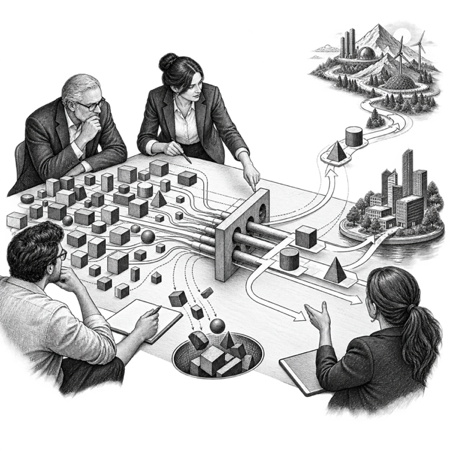
For companies and mission-led organisations

Strategy that can survive contact with the system.

Peripeteia helps leadership teams work with feedback, competing priorities, organisational boundaries and the institutional conditions beneath them—before complexity becomes another failed transformation.

Explore the contexts↓

Where complexity becomes practical

Business challenges arrive as portfolios of interacting pressures.

Growth affects capacity. Sustainability commitments affect investment and operations. New technology changes roles, information and power. A systems approach connects these pressures without pretending they can be reduced to one KPI.

Peripeteia in practice ·companies and mission-led organisations

See why sensible strategies produce stubborn results.

Choose a familiar business challenge. We will move from its conventional explanation to two deeper readings—and show where a more useful intervention becomes possible.

Lens 01

Inquiry · Action · Interaction

Capacity grows through a recurring practice, not a one-off diagnosis.

  1. Inquiry

    Ask how the priority competes with existing targets, budgets, approvals and demands—and how leadership decisions contribute to that competition.

  2. Action

    Use one real portfolio decision as a learning experiment: make the trade-off explicit, change one allocation and define what evidence will be reviewed.

  3. Interaction

    Compare what executives, middle managers and delivery teams believe the priority requires. Treat the differences as information about the system.

Lens 02

The Institutional Lens

What keeps the current pattern legitimate, expected and repeatable?

Rule
Budgets and performance measures still reward established business-unit outcomes.
Norm
Urgent operational work is protected; transformation work is expected to fit around it.
Value
Predictability and control are rewarded more visibly than exploration.
Belief
A well-communicated strategy should translate into coordinated action.
The systemic turn

The execution gap may be an institutional design success, not a motivation failure.

TRY THISChoose one declared priority and identify the rule, norm, value and belief that make the opposite behaviour reasonable.
01

Strategy & portfolio choices

Connect ambitions, constraints and initiatives so that priorities become a coherent set of choices.

  • Too many strategic priorities
  • Projects compete for the same capacity
  • Short-term performance crowds out renewal

02

Sustainable transformation

Translate environmental and social intent into operating choices across the organisation and its wider value system.

  • Targets are detached from decisions
  • Benefits appear in one area while costs move elsewhere
  • Teams lack a shared model of change
03

Digital, data & AI change

Examine how new technology changes work, judgement, coordination, risk and capability—not only process speed.

  • A tool is treated as the transformation
  • Automation creates hidden work
  • Ownership and escalation remain unclear
04

Operating model & viability

Balance local autonomy with coordination, strategic intelligence, governance and a clear organisational identity.

  • Decisions escalate unnecessarily
  • Teams optimise locally
  • Signals from the environment arrive too late
05

Supply and value networks

Look beyond the focal organisation to dependencies, incentives, delays and shared vulnerabilities across partners.

  • Recurring disruptions
  • Conflicting partner incentives
  • Risk is transferred rather than reduced
06

Leadership & collaboration

Make differing assumptions and goals discussable so leaders can act without false consensus.

  • The same debate keeps returning
  • Stakeholders define success differently
  • Difficult trade-offs remain implicit

Ways to begin

Choose a starting format—or begin with the situation itself.

Indicative formats and durations. We agree participants, session time, preparation, accessibility needs and outputs together before an engagement begins.

01

2–4 weeks

Complexity Diagnostic

A focused inquiry that frames a strategic or sustainability challenge and identifies the most useful Praxis movement.
What to expect: programme scope and learning evidence

Indicative planning guidance—not a fixed package or a claim of results. Confirm the scope and suitability together.

Who it is for
Decision-makers and colleagues who experience the challenge differently.
Situation or need
Understanding a challenge across organisational boundaries and identifying responsible, revisable next steps.
Duration
2–4 weeks; indicative and subject to an agreed schedule.
Delivery and group size
Facilitated in person, online or blended by agreement. As a starting planning range, consider 6–20 participants with smaller working groups; larger or specialist groups need an adapted facilitation plan.
Activities
Map the situation, compare interpretations and identify evidence gaps.
Tangible outputs
A provisional challenge map, explicit assumptions and options for the next inquiry.
Intended learning
Explain a boundary choice, consider another perspective, distinguish claims from evidence and revise a proposed action when assumptions change.
Evaluation
Compare starting and closing reflections, discuss learner-created artefacts and invite feedback. Agree a later application review where proportionate. Attendance alone is not learning evidence.
Reuse
Agree facilitation notes, reusable prompts and permitted use of materials. Support an internal facilitator where relevant; do not assume rights to redistribute third-party content.
Access and inclusion
Offer non-drawing and paper alternatives, accessible text and supported participation. Discuss language, time, technology and representation barriers before delivery.
Agree with the partner
Purpose, participant selection, responsibilities, schedule, costs, accessibility, outputs, reuse permissions, consent, data handling and evaluation expectations.
How learning may be reviewed →
Discuss the fit →
02

4–8 weeks

Systems Strategy Lab

A facilitated process that maps drivers and perspectives, develops options and creates shared strategic direction.
What to expect: programme scope and learning evidence

Indicative planning guidance—not a fixed package or a claim of results. Confirm the scope and suitability together.

Who it is for
A cross-functional group with authority to explore responses and access to affected perspectives.
Situation or need
Understanding a challenge across organisational boundaries and identifying responsible, revisable next steps.
Duration
4–8 weeks; indicative and subject to an agreed schedule.
Delivery and group size
Facilitated in person, online or blended by agreement. As a starting planning range, consider 6–20 participants with smaller working groups; larger or specialist groups need an adapted facilitation plan.
Activities
Compare possible responses, dependencies and unintended consequences.
Tangible outputs
A set of response options, decision criteria and a limited experiment to test the preferred direction.
Intended learning
Explain a boundary choice, consider another perspective, distinguish claims from evidence and revise a proposed action when assumptions change.
Evaluation
Compare starting and closing reflections, discuss learner-created artefacts and invite feedback. Agree a later application review where proportionate. Attendance alone is not learning evidence.
Reuse
Agree facilitation notes, reusable prompts and permitted use of materials. Support an internal facilitator where relevant; do not assume rights to redistribute third-party content.
Access and inclusion
Offer non-drawing and paper alternatives, accessible text and supported participation. Discuss language, time, technology and representation barriers before delivery.
Agree with the partner
Purpose, participant selection, responsibilities, schedule, costs, accessibility, outputs, reuse permissions, consent, data handling and evaluation expectations.
How learning may be reviewed →
Discuss the fit →
03

Multi-session

Transformation Learning Partnership

Capability-building around a live transformation, combining systems diagnosis, leadership learning and adaptation.
What to expect: programme scope and learning evidence

Indicative planning guidance—not a fixed package or a claim of results. Confirm the scope and suitability together.

Who it is for
Teams and leaders responsible for sustaining organisational change.
Situation or need
Understanding a challenge across organisational boundaries and identifying responsible, revisable next steps.
Duration
Multi-session; indicative and subject to an agreed schedule.
Delivery and group size
Facilitated in person, online or blended by agreement. As a starting planning range, consider 6–20 participants with smaller working groups; larger or specialist groups need an adapted facilitation plan.
Activities
Repeat inquiry, practice and review around challenges from everyday work.
Tangible outputs
A record of learning, revised practices and the capacity to continue the inquiry internally.
Intended learning
Explain a boundary choice, consider another perspective, distinguish claims from evidence and revise a proposed action when assumptions change.
Evaluation
Compare starting and closing reflections, discuss learner-created artefacts and invite feedback. Agree a later application review where proportionate. Attendance alone is not learning evidence.
Reuse
Agree facilitation notes, reusable prompts and permitted use of materials. Support an internal facilitator where relevant; do not assume rights to redistribute third-party content.
Access and inclusion
Offer non-drawing and paper alternatives, accessible text and supported participation. Discuss language, time, technology and representation barriers before delivery.
Agree with the partner
Purpose, participant selection, responsibilities, schedule, costs, accessibility, outputs, reuse permissions, consent, data handling and evaluation expectations.
How learning may be reviewed →
Discuss the fit →
04

30 minutes

First Exploratory Dialogue

A no-obligation first conversation to explore the situation, clarify what matters and decide whether—and how—a systems inquiry could help.Discuss the fit →
05

Open format

Open Enquiry

For situations that do not fit a predefined context. Bring the challenge in your own words and we will find a useful starting point together.Discuss the fit →

Use this today ·Reveal

Play the decision forward.

Before approving an initiative, sketch the first expected benefit, how people will respond, which capacity it consumes and what will be visible only after a delay.

ASK NOWIf this works exactly as intended, which new pressure will it create?
More everyday principles →

Begin with the situation

Bring us the challenge before deciding where the inquiry should begin.

Explore your challenge →Explore the Peripeteia Praxis →

Start a conversation

Bring the situation before choosing the solution.

Tell us what is happening, who is involved and what feels difficult to move. We will use the first conversation to understand whether a focused inquiry, learning format or longer partnership is useful.


Email
kontakt@peripeteia.de
WhatsApp
+49 171 2058188
First response
Usually within two working days
01 · Your starting point

Prepare a message here, then send it from your email app or WhatsApp. This form does not submit it directly. Fields marked with * are required.

Optional partnership details

Share what you know. No project specification is required. Please do not include sensitive personal or health information.

Preferred reply *

Contact