Education & research

Teach connections. Build the capacity to question.

For educators, universities and research teams who want learners to work thoughtfully with complexity—not simply memorise another framework. Connect disciplinary knowledge to real situations, competing perspectives and responsible action.

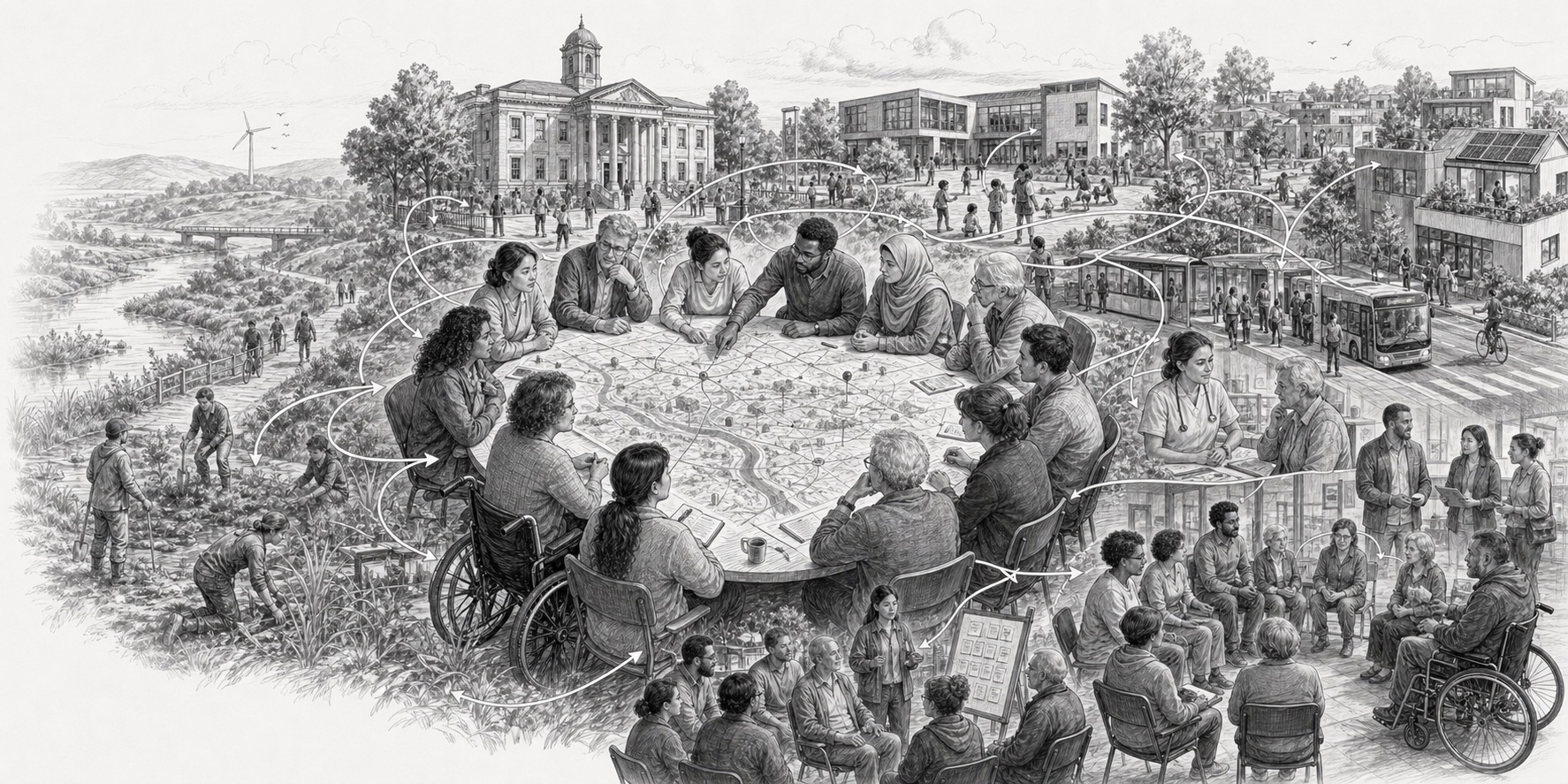
Illustrated relationships between people, organisations and their wider setting
Different perspectives. Connected consequences.

A useful starting question

Can learners explain not only their answer, but whose perspective and which assumptions made it possible?

From understanding to practice

What the work can make possible

01

See a situation differently

Learners compare accounts of a familiar challenge, identify whose voice is missing and explain what they have included or left outside their inquiry.

A possible output

Two rich pictures with a short account of perspective, boundaries and unresolved questions.

02

Explain change over time

Connect an observed pattern to a tentative explanation. Explore feedback, accumulation and delay while distinguishing observations from causal claims.

A possible output

A behaviour-over-time sketch and a causal map, with assumptions that can be challenged.

03

Learn through a responsible test

Compare possible responses, consider unintended effects and design a proportionate experiment. Assess the quality of reasoning as well as the proposed answer.

A possible output

A learning portfolio: model revisions, peer critique and a test with explicit review questions.

Ways to work together

Start small. Build from what you learn.

These are starting formats, not fixed packages. Participants, accessibility needs, time commitment and outputs are agreed together before work begins.

Systems & MINT Learning Lab

Educators and learners work through a shared case, practise mapping and reflect on how their explanation changes. The group leaves with a worked example and prompts for further inquiry.

What to expect: programme scope and learning evidence

Indicative planning guidance—not a fixed package or a claim of results. Confirm the scope and suitability together.

Who it is for
Educators and learners, with the level and format adapted to the group.
Situation or need
Connecting knowledge across disciplines and learning to question assumptions, boundaries and consequences.
Duration
Agree a short introductory session, a sequence of workshops or a longer supported pilot according to the learning question.
Delivery and group size
Facilitated in person, online or blended by agreement. As a starting planning range, consider 6–20 participants with smaller working groups; larger or specialist groups need an adapted facilitation plan.
Activities
Investigate a case, build and question a model, then reflect on the explanation.
Tangible outputs
Worked maps, learning prompts and a record of assumptions learners can revisit.
Intended learning
Explain a boundary choice, consider another perspective, distinguish claims from evidence and revise a proposed action when assumptions change.
Evaluation
Compare starting and closing reflections, discuss learner-created artefacts and invite feedback. Agree a later application review where proportionate. Attendance alone is not learning evidence.
Reuse
Agree facilitation notes, reusable prompts and permitted use of materials. Support an internal facilitator where relevant; do not assume rights to redistribute third-party content.
Access and inclusion
Offer non-drawing and paper alternatives, accessible text and supported participation. Discuss language, time, technology and representation barriers before delivery.
Agree with the partner
Purpose, participant selection, responsibilities, schedule, costs, accessibility, outputs, reuse permissions, consent, data handling and evaluation expectations.

How learning may be reviewed →
Discuss this format →

Curriculum Pilot

An educator team selects one teaching context, co-designs an activity and agrees how learning will be observed. Review learner work before deciding whether to extend the approach.

What to expect: programme scope and learning evidence

Indicative planning guidance—not a fixed package or a claim of results. Confirm the scope and suitability together.

Who it is for
Educators, facilitators and participating learners; adapt to prior experience and the institution’s context.
Situation or need
Connecting knowledge across disciplines and learning to question assumptions, boundaries and consequences.
Duration
Agree a short introductory session, a sequence of workshops or a longer supported pilot according to the learning question.
Delivery and group size
Facilitated in person, online or blended by agreement. As a starting planning range, consider 6–20 participants with smaller working groups; larger or specialist groups need an adapted facilitation plan.
Activities
Explore a situation, compare perspectives, construct and challenge an account, then identify what to investigate or try next.
Tangible outputs
Maps or written accounts, explicit assumptions, learning questions and an agreed next-step record.
Intended learning
Explain a boundary choice, consider another perspective, distinguish claims from evidence and revise a proposed action when assumptions change.
Evaluation
Compare starting and closing reflections, discuss learner-created artefacts and invite feedback. Agree a later application review where proportionate. Attendance alone is not learning evidence.
Reuse
Agree facilitation notes, reusable prompts and permitted use of materials. Support an internal facilitator where relevant; do not assume rights to redistribute third-party content.
Access and inclusion
Offer non-drawing and paper alternatives, accessible text and supported participation. Discuss language, time, technology and representation barriers before delivery.
Agree with the partner
Purpose, participant selection, responsibilities, schedule, costs, accessibility, outputs, reuse permissions, consent, data handling and evaluation expectations.
How learning may be reviewed →
Discuss this format →

Institutional Learning Partnership

Educators, facilitators and programme leads develop repeatable practice together. Combine supported inquiry, facilitation development and a shared review of what learners can now do.

What to expect: programme scope and learning evidence

Indicative planning guidance—not a fixed package or a claim of results. Confirm the scope and suitability together.

Who it is for
Programme leads, educators or facilitators and participating teams.
Situation or need
Connecting knowledge across disciplines and learning to question assumptions, boundaries and consequences.
Duration
Agree a short introductory session, a sequence of workshops or a longer supported pilot according to the learning question.
Delivery and group size
Facilitated in person, online or blended by agreement. As a starting planning range, consider 6–20 participants with smaller working groups; larger or specialist groups need an adapted facilitation plan.
Activities
Develop supported practice, review learning and adapt the approach to the institution.
Tangible outputs
Reusable learning activities, facilitation experience and an agreed approach to reviewing progress.
Intended learning
Explain a boundary choice, consider another perspective, distinguish claims from evidence and revise a proposed action when assumptions change.
Evaluation
Compare starting and closing reflections, discuss learner-created artefacts and invite feedback. Agree a later application review where proportionate. Attendance alone is not learning evidence.
Reuse
Agree facilitation notes, reusable prompts and permitted use of materials. Support an internal facilitator where relevant; do not assume rights to redistribute third-party content.
Access and inclusion
Offer non-drawing and paper alternatives, accessible text and supported participation. Discuss language, time, technology and representation barriers before delivery.
Agree with the partner
Purpose, participant selection, responsibilities, schedule, costs, accessibility, outputs, reuse permissions, consent, data handling and evaluation expectations.
How learning may be reviewed →
Discuss this format →

Decision support, not a blueprint.

We make perspectives, assumptions and trade-offs visible. Maps and models support inquiry; they do not replace professional judgement, democratic accountability or the people affected by a decision.

Understand our approach →

Start a conversation

Bring the situation before choosing the solution.

Tell us what is happening, who is involved and what feels difficult to move. We will use the first conversation to understand whether a focused inquiry, learning format or longer partnership is useful.

Email
kontakt@peripeteia.de
WhatsApp
+49 171 2058188
First response
Usually within two working days
01 · Your starting point

Prepare a message here, then send it from your email app or WhatsApp. This form does not submit it directly. Fields marked with * are required.

Optional partnership details

Share what you know. No project specification is required. Please do not include sensitive personal or health information.

Preferred reply *

Contact