

Life · idea · continuing relevance
Stafford Beer
Management cybernetician · organisational designer
01 · LIFE AND CONTEXT
The person behind the pattern.
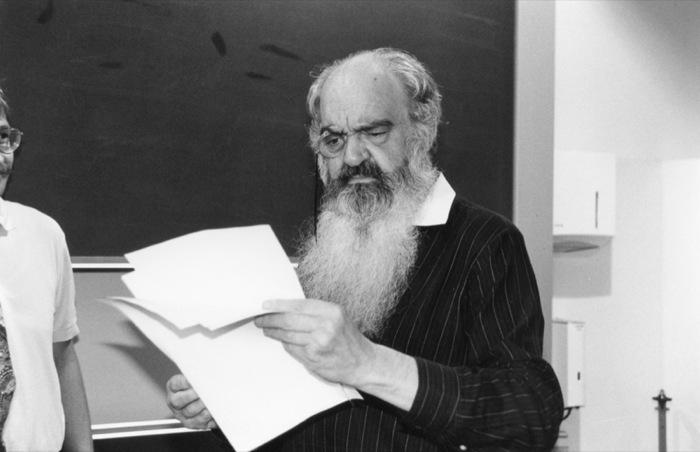
Stafford Beer brought cybernetics into operational management after early work in the steel industry. He built models, consultancy practices and participatory processes, and advised Chile’s Project Cybersyn during Salvador Allende’s government.
His career joined rigorous organisational theory with a radical interest in autonomy, participation and institutions capable of adapting.
02 · THE CENTRAL IDEA
What changed through this work?
The Viable System Model identifies interacting functions needed for an organisation to maintain identity in a changing environment: operations, coordination, control, intelligence and policy.
Viability depends on recursion and balance. Operational units require meaningful autonomy, while the whole needs sufficient cohesion and environmental intelligence.
03 · WHY IT MATTERED
A contribution to systems practice.
Beer translated Ashby’s cybernetics into a powerful organisational architecture and challenged command-and-control assumptions about coordination.
Peripeteia perspective
Reading the idea for today.
A VSM diagnosis should not become a new hierarchy chart. Its value is to ask where decisions belong, whether information reaches the right level and whether today’s operations are crowding out tomorrow’s intelligence.
TRY THE IDEABalance operational autonomy with coordination, intelligence and a coherent identity.
This section is Peripeteia’s contemporary interpretation—not a quotation or a claim made on the thinker’s behalf.
Connections across the library
No idea develops alone.
Selected starting points
Read the thinker in their own voice.
Show sources and reading list
- Brain of the Firm
- The Heart of Enterprise
- Diagnosing the System for Organizations
Titles are a curated orientation, not a complete bibliography. This profile is an original editorial synthesis informed by the Systems Thinkers collection and additional historical context.