

Life · idea · continuing relevance
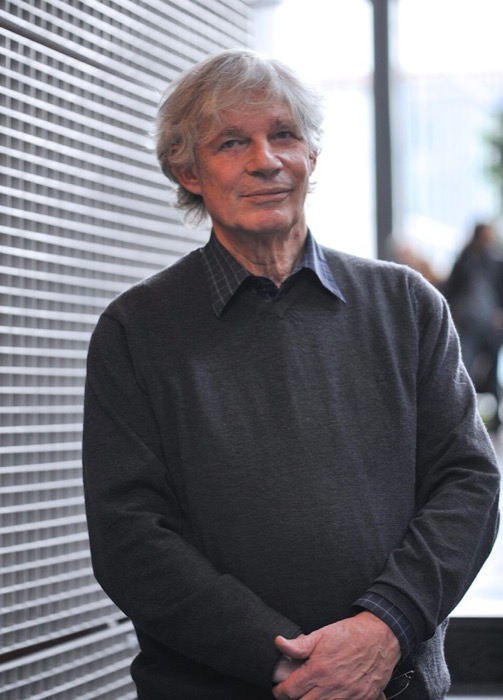
Stuart Kauffman
Theoretical biologist · complexity scientist
01 · LIFE AND CONTEXT
The person behind the pattern.
Stuart Kauffman trained in medicine and theoretical biology, then became one of the formative researchers associated with the Santa Fe Institute. His work crosses genetics, evolution, self-organisation and the origins of novelty.
He has repeatedly pursued questions that sit between established disciplines, using formal models to explore how order can arise without central design.
02 · THE CENTRAL IDEA
What changed through this work?
Kauffman studied networks poised between rigid order and chaotic change, as well as fitness landscapes that make adaptation path-dependent. The ‘adjacent possible’ describes possibilities opened by what already exists.
Self-organisation complements natural selection by explaining why certain forms and regularities may arise before selection acts on them.
03 · WHY IT MATTERED
A contribution to systems practice.
Kauffman expanded complexity science’s vocabulary for emergence, innovation and evolutionary search across biological and social domains.
Peripeteia perspective
Reading the idea for today.
The adjacent possible offers a disciplined alternative to grand transformation plans: create conditions for diverse, connected experiments, then learn which new capabilities make further options reachable.
TRY THE IDEAExplore several nearby possibilities instead of attempting to design the final state from the start.
This section is Peripeteia’s contemporary interpretation—not a quotation or a claim made on the thinker’s behalf.
Connections across the library
No idea develops alone.
Selected starting points
Read the thinker in their own voice.
Show sources and reading list
- The Origins of Order
- At Home in the Universe
- Investigations
Titles are a curated orientation, not a complete bibliography. This profile is an original editorial synthesis informed by the Systems Thinkers collection and additional historical context.